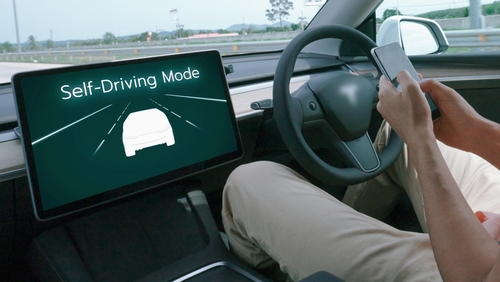
If you were injured in an accident with a self-driving vehicle, you’re probably wondering: who’s actually responsible? The accident can be confusing because you don’t know whether to pursue a claim against a company, a manufacturer, or even another driver.
Self-driving technology is no longer science fiction. These vehicles are already on our roads, and their numbers are growing rapidly. According to data from the National Highway Traffic Safety Administration (NHTSA), there has been a significant increase in autonomous vehicle crashes over recent years.
Our team at Shapiro, Washburn & Sharp has decades of experience holding negligent parties responsible in a wide variety of car accidents, including those involving self-driving cars. In this article, we’ll explain the issues you’re up against if you were hurt in a crash like this. For more information on your particular case, contact us at 833-997-1774 for a free consultation today.
Are Self-Driving Vehicles Safer?
The idea behind autonomous vehicles is compelling, as some public-health analyses suggest that widespread adoption could dramatically reduce traffic deaths. According to research, human error—such as impairment, distraction, or bad judgment—causes the vast majority of fatal crashes.
Still, despite improvements in self-driving technology, the safety advantages of self-driving cars, according to the Governance Studies Media Office, remain “aspirational.” In April 2024, the nation’s premier association for computer engineers, the Association for Computing Machinery, warned policymakers that they “should not assume that fully automated vehicles will necessarily reduce road injuries and fatalities.”
The simplest reason for this is that computers can make mistakes, too. Several accidents have occurred with self-driving vehicles, some of them resulting in human fatalities. Computer vision systems can misperceive road signs, and computer perception systems can malfunction in unpredictable ways.
And in a 2024 analysis of autonomous versus human-driven vehicle accidents, crashes involving vehicles equipped with advanced driving systems generally had a lower chance of occurring than human-driven vehicles in most similar accident scenarios. But accidents involving advanced driving systems occurred more frequently than human-driven vehicle accidents at dawn/dusk or in turning conditions, which are 5.25 and 1.98 times higher, respectively.
Clearly, self-driving cars are not perfect, and accidents with them can happen. What, then, do injured victims do about recovering damages?
What Are the Common Causes of Self-Driving Vehicle Accidents?
Even though self-driving vehicles are designed to help eliminate human error, many accidents still occur due to various failures. Some common causes include the following.
Technology Failures and Sensor Issues
Autonomous vehicles rely on an intricate network of sensors, cameras, and radar systems to “see” the world around them. When these systems malfunction or misinterpret information, accidents can happen. Common incidents have included crashes with stopped emergency vehicles, phantom braking, wrong-way driving, and failures to detect pedestrians and cyclists.
Software glitches present another significant danger. The computer programs controlling these vehicles have to make split-second decisions about speed, braking, and steering. A coding error or unexpected bug can cause the vehicle to react incorrectly or not at all. Sometimes the software encounters a situation it wasn’t programmed to handle, like unusual weather conditions or road construction that doesn’t match its digital maps.
Environment or Connection Limits
Unlike humans, self-driving systems can’t “guess” or “sense” things outside their programmed abilities. They can only react to what their sensors detect and what their programming understands. Research shows that autonomous systems can struggle in real-world conditions, such as when the lighting is poor, the weather is bad, or when other drivers behave in unpredictable ways.
A 2020 study involving autonomous vehicle perception systems found that performance can drop significantly when the system faces unfamiliar or complex environments, or when sensors lose accuracy due to lighting or weather.
Overreliance on Self-Driving Technology
Many cars are advertised as “self-driving” but still require a human driver to pay attention and take over quickly when needed. But some drivers assume a car can handle everything and stop paying attention. If the system suddenly needs the human to take control, the driver may not react in time, turning a small problem into a serious crash.
Interactions with Human Drivers
Finally, many crashes happen because of mistakes made by human drivers. Research examining autonomous-vehicle crash patterns shows that many reported accidents occur when a regular driver rear-ends a self-driving car or hits it while changing lanes or turning.
In other words, even if the autonomous vehicle is driving appropriately, a human driver’s error can still cause a collision.
All of these examples show that while self-driving cars can reduce some safety risks, they also introduce new challenges. To figure out who is responsible after a crash, it’s important to understand how the technology works and the limits it has.
Who is Liable in a Self-Driving Crash?
Liability in a self-driving accident depends on the circumstances.
Manufacturer Liability
If the self-driving car’s automated system failed because of a defect, then liability may rest with the manufacturer or developer of the autonomous system (the software company). For example, if a self-driving car is driving down a street at night and a pedestrian steps into the crosswalk, the car’s sensors should detect the person there. If a software glitch causes the system to misread the scene and not brake in time, injuring the pedestrian, the manufacturer or developer may be responsible for the crash.
Maintenance and Repair Company Negligence
Self-driving technology requires regular updates and maintenance. If a repair shop didn’t repair the vehicle properly or failed to install critical software updates, they may share in fault for the accident.
Government Entities
Sometimes the accident isn’t caused by the car or its driver but by dangerous road conditions. Poorly marked construction zones, malfunctioning traffic signals, or misleading road signs can confuse autonomous systems. If a government agency’s negligence in maintaining roads or traffic infrastructure contributed to the accident, it may share in liability.
Human Negligence
Many autonomous vehicles still require a human to take control when needed. If the person behind the wheel doesn’t follow the rules or ignores warnings, they can still be the one at fault. For example, imagine a driver turns on the car’s “autopilot” feature, then the car flashes warnings telling the driver to keep their hands on the wheel. The driver looks at their phone instead, and the car rear-ends another vehicle. In that case, the driver would be responsible for the crash.
Third-Party Negligence
Sometimes, the self-driving car is doing what it’s supposed to do, but another human driver makes a bad decision and causes a collision.
For example, imagine a self-driving car is stopped at a red light. Another driver who is texting while driving doesn’t notice that traffic has stopped and slams into the back of the autonomous vehicle. Here, the texting driver is clearly the one at fault.
Shared Liability
Sometimes, there are situations where the technology performs poorly, but the human driver also fails to react correctly. In these cases, responsibility may be shared, depending on state law.
Imagine a self-driving car shifts too close to the center line because its lane-keeping camera gets confused by faded paint on the road. At the same time, the human backup driver is supposed to be watching, but is glancing at the navigation screen instead of the road. The car sideswipes another vehicle, causing an accident.
Here, investigators may say the manufacturer made a system that didn’t “see” the lane correctly, but the human driver also failed to take control quickly, meaning both played a part in causing the crash.
Challenges Under Virginia’s Contributory Negligence Rule
In some states, including Virginia, if you are even slightly at fault for a car accident, you may be barred from recovering any of your damages at all. This is called “pure contributory negligence.” It means that if an injured person contributed to the accident even as little as one percent, the defendant or at-fault entity does not owe any compensation, even if that party was 99 percent at fault.
Because most self-driving systems still require the human driver to be ready to take over, manufacturers often argue that the occupant misused the system or should have been ready to intervene and didn’t. That can make it harder for injured people to recover damages.
How A Car Accident Lawyer Can Help
Having an experienced car accident lawyer on your side helps you build a strong argument in your favor. At Shapiro, Washburn & Sharp, we will work to gather the evidence needed to make it harder for anyone to claim you contributed to the accident. Our goal is to obtain the autonomous vehicle’s data logs and system records. Self-driving cars record detailed information about their operation, including what the sensors detected, how the system responded, and whether any warnings were issued. This may be evidence of fault.
If you or a loved one was injured in an accident with a self-driving car, contact our offices right away. We will trace the chain of liability from the human operator to the vehicle manufacturer and software developer, as well as any other potentially liable parties.
We recently managed a case where a disabled veteran was hit by a negligent driver running a red light. She suffered multiple injuries, but the at-fault party tried to argue that they were caused by her preexisting conditions. We gathered the evidence to prove that the car accident was the reason these injuries were seriously aggravated, and successfully negotiated a $520,000 insurance settlement.
We have offices to serve you in Virginia Beach, Suffolk, Hampton, Portsmouth, Norfolk, and Chesapeake.