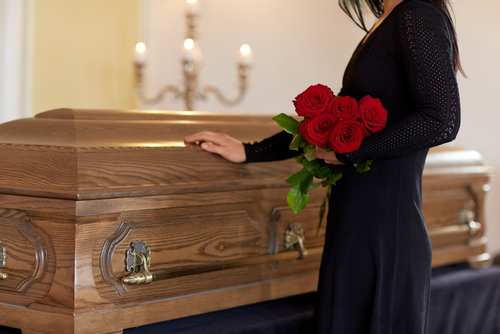
Funeral homes in Virginia and every state have a duty when they are entrusted with handling the body of a deceased person to properly embalm and present the body of the deceased family member. The funeral home must also carefully handle and transport a loved one’s body throughout all stages of care, from handling before the funeral to burial, if the home coordinates burial activities as well.
Our firm has successfully handled several funeral home liability cases. Our firm recently handled a well-publicized funeral home liability case representing a Chesapeake family who were devastated at the condition their loved one’s body was in when presented to them at the funeral ceremony. Their loved one’s face, nose, and mouth were covered with clumps of maggots, to the horror of the immediate and close family members.
The mother of the deceased person authorized our firm to file suit against the Defendants involved in the case. Allegations against the defendant funeral homes included in our lawsuit include:
- Defendants failed to properly inspect and preserve his body upon receipt of his remains.
- Defendants failed to clean and inspect the decedent for insect infestation.
- Defendants failed to inspect, clean, and maintain the deceased person’s body before his service.
During litigation, both Defendants denied any failures and hired an expert witness in funeral home liability to defend their conduct.
After the local NBC affiliate and its correspondent, Andy Fox, aired the story in June 2025, media and news outlets, not only in Virginia but also within the United States and beyond, covered the story of what happened to the family in this case.
Firm partner Kevin Sharp, along with firm partner Eric Washburn and associate attorney Andrew Stover, represent the involved family. Attorney Sharp referred the media to the Complaint filed in this funeral home liability case, and issued the following statement:
“What Hollomon-Brown Funeral Home has done to Torreon Williams’ family, especially his mother, Tabitha, is nothing short of shocking, deeply disturbing, and absolutely heartbreaking. Hollomon-Brown was entrusted with the responsibility of providing this young man a dignified viewing – one that would allow his family to mourn his passing with grace and respect. Instead, Hollomon-Brown subjected them to an unimaginable horror – an experience so traumatic it continues to haunt them to this day.”
Embalming Practices in Funeral Homes
To maintain a decedent in the “Fresh” category, one manner of slowing the progression of the natural process of decomposition is to use refrigeration, which is widespread throughout the funeral industry. The purpose of refrigeration is “to slow postmortem changes in the deceased body” (Gee-Mascarello 2022). Refrigeration, as defined by the Model Disposition Standards for Funeral Service (2023) by the International Conference of Funeral Service Examining Boards, is “a climate-controlled environment using mechanical means which maintains a temperature of 40 degrees Fahrenheit or less.”
Another manner of slowing the progression of the natural process of decomposition to maintain a decedent in the “Fresh” category is by embalming. As described by Edward C. Johnson, an embalming and funeral historian, “Embalming is a means of artificially preserving the dead human body, and it is one of humankind’s longest practiced arts” (Mayer 2012).
Embalming dates back to around 3000 BC, with the ancient Egyptians’ practice of preserving bodies to maintain their recognizable state. Today, the American Board of Funeral Service Education (ABFSE) defines embalming as “The chemical treatment of the dead human body to reduce the presence and growth of microorganisms, to temporarily inhibit organic decomposition, and to restore the dead human body to an acceptable physical appearance” (ABFSE Embalming Glossary 2022). Although techniques have evolved with technological advances and new chemicals have been invented, the reason for embalming remains the same: temporary preservation of the dead.
Purposes of Funeral Ceremonies
According to Klicker (2007), the American Board of Funeral Service Education (1998) listed the following values of funeralization and the funeral ceremony:
- Provides an opportunity to receive and express love.
- Shows respect to the deceased’s family and friends.
- Provides an opportunity to express grief.
- Provides a face-to-face confrontation with death, which confirms its reality.
- Allows emotional support through sharing- “Joy expressed is joy increased, grief shared is grief diminished.”
- Meets the needs theologically, psychologically, and socially of those who mourn.
- Provides an opportunity for farewell through ritual.
- Provides a dramatic representation of the fact that a life has been lived by reflecting upon memories of the deceased.
- Helps establish emotional stability through a social support network.
- Establishes a socially acceptable climate for mourning.
Funeral Homes Should Document Important Activities Related to Preservation and Handling of the Deceased’s Body
When a funeral home enters a contract with a family, the funeral home “promises to undertake certain obligations” (Gilligan and Stueve, 2011) to prevent acts of negligence and mutilation of the body, while safeguarding the body of the decedent, and preventing further mental anguish to a family who is already grieving. “Due diligence” is a phrase that should be upheld in every funeral home, with every case, with every family, every time. Due diligence should be the backbone of every funeral home, which leads to greater transparency and trust within its community. A vital aspect of due diligence is documentation; funeral homes must document the various important steps taken to preserve the bodies of all the deceased persons they contract to handle, transport, and present.
Call Our Personal Injury Law Firm for Legal Assistance
The personal injury lawyers at Shapiro, Washburn & Sharp collectively have more than 100 years of experience vigorously pursuing full compensation for clients against all responsible parties. Since 1985, we’ve been helping clients and their families regain their lives, recovering over $100 million in settlements and verdicts on their behalf. For many years, we have been named a “Best Law Firm” in personal injury law by that prestigious legal ranking organization.
No matter what type of injury case you have, you can be assured that our lawyers will aggressively advocate on your behalf. There is no fee unless compensation is recovered. As a full-service injury law firm, we will advance all litigation expenses on your behalf, so you won’t need to pay any costs to support your case while litigation is ongoing.
Contact our office today for a free and confidential case evaluation. For your convenience, we have offices in Virginia Beach, Portsmouth, Hampton, Norfolk, and Chesapeake.