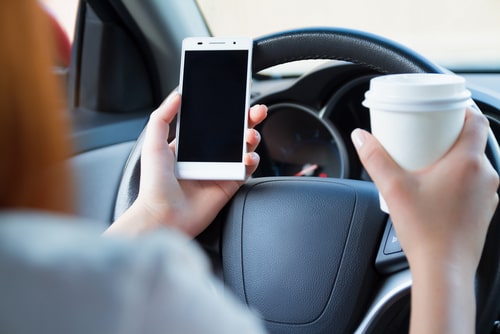
April is Distracted Driving Awareness Month, and for good reason. Despite years of public campaigns, stronger laws, and widespread awareness of the risks, distracted driving continues to injure and kill people on roads across the country every single day. It remains one of the most preventable causes of serious car accidents — and one of the most persistent.
As Virginia Beach car accident attorneys, we see the real-world consequences of distracted driving in our work year after year. The injuries are often serious. The financial impact on families is significant. And far too often, victims don’t fully understand what they’re entitled to recover.
What Is Distracted Driving?
Distracted driving is any activity that pulls a driver’s attention away from the task of operating a vehicle safely. Texting is the most talked-about example, but it’s far from the only one. Eating, adjusting the radio, looking at a GPS, talking to passengers, and even extended daydreaming all qualify.
The National Highway Traffic Safety Administration (NHTSA) categorizes driver distractions into three types:
- Visual — taking your eyes off the road
- Manual — taking your hands off the wheel
- Cognitive — taking your mind off driving
Texting while driving is widely considered the most dangerous distraction because it combines all three at once. At 55 mph, glancing at a message for five seconds means traveling the full length of a football field without watching the road. Most people underestimate how much can change in that amount of time.
According to the NHTSA, distracted driving claimed 3,208 lives in 2024, with an estimated 315,167 people injured in crashes involving a distracted driver that same year.
The Dangers of Distracted Driving
The physical risks are serious and extend beyond what most drivers stop to consider. When a driver is distracted, several things happen simultaneously.
Loss of Focus
Even a brief lapse in attention can cause the driver to miss a traffic signal, fail to notice a vehicle stopped ahead, or overlook a pedestrian stepping into the roadway. By the time they look back at the road, the situation may have already changed beyond their ability to respond safely.
Delayed Reaction Time
Reaction time is everything in a split-second emergency. A driver who is actively looking at their phone, eating, or absorbed in a conversation is operating on a significant delay. That delay can be the difference between a near miss and a serious collision.
Impaired Decision-Making
Distracted drivers are less able to accurately assess risk. They may misjudge speeds, gaps in traffic, or whether they have time to make a turn. These misjudgments lead directly to crashes.
Inattention Blindness
Research has documented a phenomenon where drivers who are cognitively distracted can look directly at something — another vehicle, a stop sign, a pedestrian — and fail to consciously register it. The eyes are open, but the brain isn’t processing what it sees.
Reduced Awareness of Surroundings
Changes in traffic conditions, cyclists in a lane, emergency vehicles approaching, road debris — a distracted driver is less likely to notice any of these until it’s too late to respond.
Higher Crash Severity
Crashes involving distracted drivers tend to be more severe than other types of collisions. Because the distracted driver is slower to react and less likely to take evasive action, impacts are more direct and at higher speeds.
Virginia’s Hands-Free Law: What Drivers Are Required to Do
Virginia law has evolved significantly in recent years. As of January 1, 2021, under Virginia Code § 46.2-818.2, it is illegal to hold a handheld personal communications device while operating a moving motor vehicle. This applies to all drivers on public roads, including at red lights and stop signs.
What this means in practice:
- You cannot hold your phone to your ear to talk
- You cannot hold your phone to read or send a message
- You cannot hold your phone for GPS navigation
- You cannot hold your phone in your hand for any purpose while the vehicle is in motion
Drivers can talk using Bluetooth, mounted devices, or a single earphone. The restriction applies to phones, tablets, and any other handheld personal communications device.
Penalties start at $125 for a first offense and $250 for subsequent offenses or violations in a work zone. If the behavior rises to the level of reckless driving, the consequences are significantly more serious, including potential fines of up to $2,500, jail time, and license suspension.
Virginia’s Department of Transportation (VDOT) reported that in 2024, there were 18,688 distraction-related crashes in the state, resulting in 73 fatalities and over 10,000 injuries. Distraction related to cell phone use actually rose 3% from 2023 to 2024, despite the hands-free law being in effect. That gap between what the law requires and what drivers actually do is where crashes happen.
The Injuries Victims Typically Face
Distracted driving accidents result in a wide range of injuries, and many of them are serious. Because the at-fault driver often reacts too late — or not at all — crashes frequently occur at or near full speed. The injuries our Virginia Beach car accident clients most commonly report include traumatic brain injuries (TBI), spinal cord damage, fractures, shoulder and joint injuries, chronic soft tissue damage, and, in the worst cases, fatalities.
Recovery from these injuries takes time. It often requires multiple rounds of treatment, physical and occupational therapy, and significant time away from work. The financial strain compounds the physical and emotional toll. Medical bills accumulate fast, and many victims don’t realize until later how extensive their long-term care needs will be.
What Damages Can Victims Recover?
Virginia law allows injured victims to seek compensation for both economic and non-economic losses following a crash caused by a negligent driver.
Economic Damages
Economic damages are the tangible, documented financial losses tied to the injury. These typically include:
- Medical expenses — hospital stays, surgeries, medications, physical therapy, rehabilitation, and anticipated future medical care
- Lost income — wages lost during recovery, and in cases of permanent disability, loss of future earning capacity
- Transportation costs — getting to and from medical appointments, or covering alternative transportation when the victim’s vehicle is out of commission
- Home modifications — in cases involving serious mobility impairments, the costs associated with making a home accessible
Non-Economic Damages
These are the losses that don’t come with a receipt but are just as real. They include:
- Pain and suffering — the physical pain and emotional distress caused by the injuries themselves
- Loss of enjoyment of life — the inability to participate in activities the victim enjoyed before the crash
- Permanent disability or disfigurement — lasting physical changes that affect a person’s quality of life, self-image, and ability to function day to day
The value of these damages depends on the severity of the injuries, their expected duration, and the extent to which they have disrupted the victim’s life. This is precisely why having experienced legal representation matters — these calculations require evidence, medical documentation, and often expert input.
How a Distracted Driving Claim Is Built
Proving that a driver was distracted at the time of a crash isn’t always straightforward. Distracted drivers rarely admit what they were doing, and there’s no standardized test for distraction the way there is for impairment. But there are meaningful ways to establish what happened.
Cell phone records can show whether the driver was actively texting, browsing, or using an app at the moment of impact. These records can be obtained through the legal discovery process. Surveillance footage from nearby traffic cameras or businesses may have captured the driver’s behavior in the seconds before the crash. Witness statements from other drivers, passengers, or bystanders who observed the at-fault driver using a phone or otherwise not paying attention can be valuable. Vehicle data recorders in modern cars can also provide information about speed, braking, and driver inputs in the moments before a collision.
Pulling this evidence together takes time and resources. It’s not something most people can manage on their own, particularly while recovering from a serious injury.
About Shapiro, Washburn & Sharp
Shapiro, Washburn & Sharp has been representing injured Virginians since 1985. Our firm’s practice is focused entirely on injury law, and our attorneys have over 100 years of combined legal experience. We handle car accident claims across Virginia, from straightforward insurance disputes to complex multi-party litigation.
Our attorneys know what it takes to build a strong case and what insurance companies look for when evaluating a claim. That knowledge has translated into more than $100 million recovered for clients throughout the firm’s history.
In one case, our firm handled a 43-year-old sales manager who was struck in Virginia Beach by a delivery driver who failed to yield the right of way at an intersection on Great Neck Road. She suffered a traumatic brain injury, a dislocated shoulder with a labral tear, thoracic disc protrusions, and was unable to work for nearly two and a half years. After building a thorough case — including referrals to a TBI subspecialist, medical illustrations, and mediation with a retired Circuit Court judge — our firm secured a $525,000 settlement on her behalf.
Talk to Our Team About Your Car Accident Claim
If you’ve been injured in a crash caused by a distracted driver, don’t wait to understand your options. Virginia has a statute of limitations on personal injury claims, and once that window closes, so does your ability to seek compensation. The Virginia Beach car accident lawyers at Shapiro, Washburn & Sharp are available 24 hours a day to answer your questions. Contact us at 833-997-1774 for a free consultation. Our firm has offices in Virginia Beach, Portsmouth, Suffolk, Hampton, Norfolk, and Chesapeake, and we’re ready to help you understand what your case is worth and what the next steps look like.