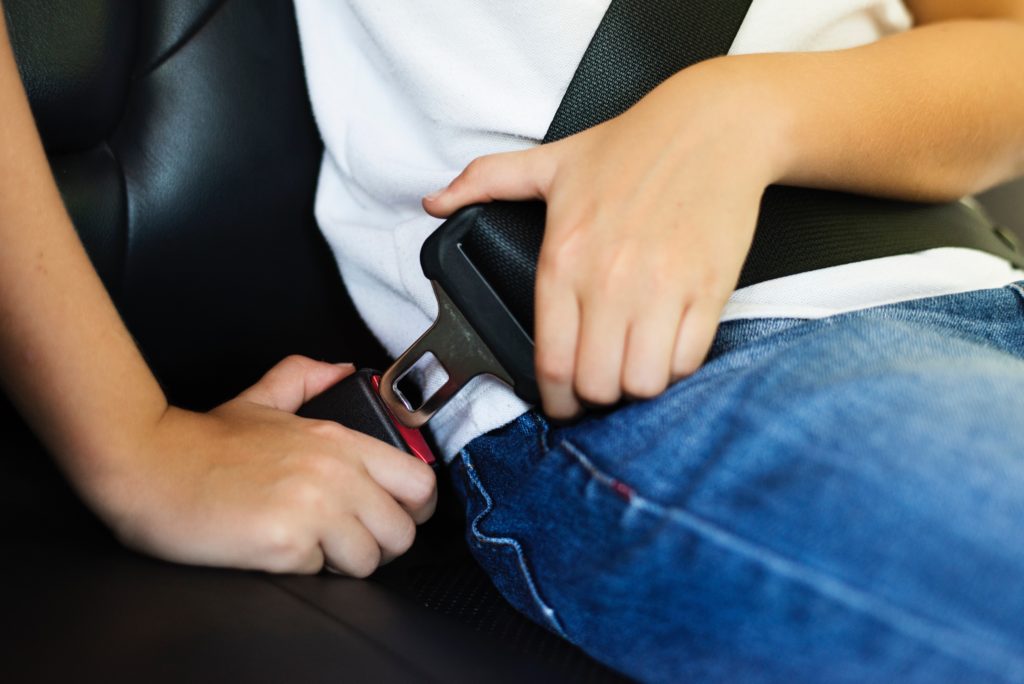
North Carolina Seatbelt Laws
With few exceptions, each person in every vehicle must buckle up, and children younger than 16 must use safety seats until they are large enough to use seatbelts designed for adults.
North Carolina state law requires that each person in a motor vehicle wear a seatbelt. The requirement applies to backseat passengers, regardless of whether they are in a car, truck, SUV, or passenger van. Children younger than 16 must be “properly secured in a child passenger restraint system or seat belt which meets federal standards applicable at the time of its manufacture.”
As personal injury attorneys in Virginia Beach and North Carolina, we encourage compliance with these laws. Buckling up saves lives. At the same time, provisions in both the seatbelt and child restraint laws make it clear that failing to use a seatbelt or forgetting to strap in a young passenger does not preclude filing and collecting on car accident insurance claims.
North Carolina has primary enforcement of seat belt laws. This means that law enforcement officers can stop and ticket drivers or passengers solely for not wearing seat belts without requiring any other traffic violation.
North Carolina has strict child safety seat laws. Children younger than eight years old or weighing less than 80 pounds must be secured in a child safety seat or booster seat appropriate for their age, weight, and height. Children who are at least eight years old or weigh 80 pounds or more must wear a seat belt.
BuckleUpNC recommends placing children younger than 12 months and weighing less than 20 pounds only in rear-facing safety seats in the backseat. The nonprofit also advises parents and caregivers to check whether a safety seat placed in the front passenger position is certified for use with an airbag.
Exemptions from the general seatbelt law (N.C.G.S. 20-135.2A) and the child restraint law (N.C.G.S. 20-137.1) exist, such as for individuals with medical conditions that prevent them from wearing seat belts. Additionally, vehicles manufactured before 1968, motorcycles, and postal vehicles are exempt from seat belt requirements.
Exemptions from the child restraint law are limited to “ambulances or other emergency vehicles; if all seating positions equipped with child passenger restraint systems or seat belts are occupied; or to vehicles which are not required by federal law or regulation to be equipped with seat belts.”
The statutory fine for a driver or front-seat passenger (16 years of age or older) who does not use a seatbelt is $25.50 plus court costs and fees. For subsequent violations, the fines may increase, and points may be added to the driver’s record. Rear-seat occupants 16 years of age or older not wearing a belt can be fined $10.
Drivers who fail to properly restrain children younger than 16 face a maximum fine of $25 and two penalty points against their license. The penalty is capped per vehicle, so transporting more than one child who is not properly restrained will not bring additional fines or points.
The law permits ticketed drivers to avoid the penalty entirely by providing the traffic court with documentation of the installation of an appropriate child safety seat.
North Carolina courts cannot consider failing to buckle up to be a type of contributory negligence. This is very important because any finding of contributory negligence invalidates personal injury and wrongful death claims.
North Carolina and Virginia are two of only four states that still follow the outdated and unjust common-law rule of contributory negligence. It is good that the seatbelt law recognizes that failing to buckle up does not cause a traffic accident.
If you were injured in a North Carolina auto accident, you must speak with an attorney about the legal options that are available to you. Contact our office to schedule a free, no-obligation consultation with a reputable North Carolina or Virginia Beach car accident lawyer from Shapiro, Washburn & Sharp. We know what it takes to see a successful resolution to your car accident case.
With few exceptions, each person in every vehicle must buckle up, and children younger than 16 must use safety seats until they are large enough to use seatbelts designed for adults.
Obstetrics and Gynaecology (often abbreviated to OB/GYN, OBG, O&G or Obs & Gynae) are the two surgical specialties dealing with the female reproductive organs, and provide care for both pregnant and non-pregnant women. Dr. Alfred Abu-HamadObstetrician / Gynecologist825 Fairfax AveEastern Virginia Medical School OBNorfolk, VA 23507 Dr. Abraham AndersonObstetrician / Gynecologist2810 Tidewater DrGynecology AssociatesNorfolk, VA…
With causes of TBIs ranging from car and truck crashes to falls, medical errors and near-drownings, some 2.5 million Americans suffer brain injuries each year.
If you have been injured in a head-on crash, contact a North Carolina car accident attorney to find out what legal recourse you may have. Call our office today.
A review of medical records published in a 2019 revealed that “moped riders are at increased risk for significant head and facial injury.”