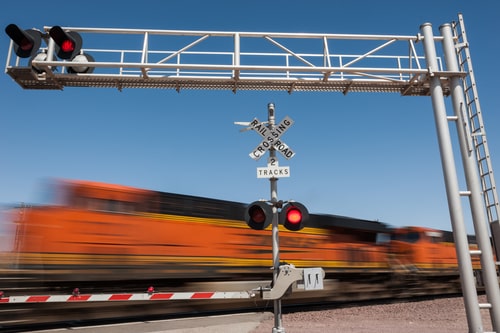
4 Common Causes of Car-Train Accidents at Railroad Crossings
Poor maintenance and avoidable errors by engineers and conductors are leading reasons that trains hit passenger vehicles at railroad crossings.
During the most recent period with complete data available, the Federal Railroad Administration (FRA) reported more than 2,150 highway-rail incidents nationwide in 2023, representing a noticeable increase from the 1,538 incidents recorded in 2019. Additionally, FRA data shows more than 1,300 non–grade crossing train accidents—including derailments, collisions between trains, and incidents involving railroad workers or trespassers on the tracks. Taken together, these categories represent thousands of preventable tragedies occurring on or near railroad property each year. Unfortunately, this upward trend reflects ongoing safety challenges throughout the rail industry.
Virginia and North Carolina — two states where our law firm frequently handles railroad injury and wrongful death cases—continue to rank in the upper half of states for train accidents and crossing collisions. According to 2024 FRA reports, Virginia recorded more than 60 highway-rail crossing incidents, while North Carolina recorded over 80, placing both states among the top 15 in the nation for crossing-related injuries and deaths. The rise in freight traffic, increased passenger rail usage, and aging infrastructure all contribute to these accident rates, as do inconsistent safety protocols across rail corporations.
Trains strike and injure — or kill — people for many reasons. Some incidents occur when drivers or pedestrians attempt to beat a train or ignore lowered gates. Others happen at uncontrolled, poorly marked, or malfunctioning crossings. Federal regulations and state laws place obligations not only on the public but also on railroads themselves. For example, Virginia Code § 46.2-885 requires drivers to stop when a train is approaching and requires locomotive engineers to sound the whistle or horn in advance of a crossing. Failure by either party to follow the law can have catastrophic consequences.
Railroad companies are quick to blame drivers or pedestrians after an accident. However, at Shapiro, Washburn & Sharp, our railroad injury lawyers have decades of experience in investigating and litigating these cases, demonstrating that railroad negligence plays a significant role in many incidents. Engineers, conductors, signal maintainers, and railroad executives often make preventable errors that place the public at risk. Four recurring categories of negligence are especially common.
Grade crossings require consistent upkeep to remain safe. FRA safety bulletins repeatedly note that failing to maintain tracks, signals, lights, and vegetation can create hazardous conditions that pose a deadly risk. Overgrown brush can block sight lines. Worn crossing boards can cause vehicles to jolt into oncoming trains. Malfunctioning warning signals can remain dark. Poorly maintained brakes, couplers, and wheels can delay a train’s stopping distance. When poorly maintained crossing conditions are the primary cause of a collision, railroads may face strict liability, meaning victims do not need additional proof of negligence to hold the railroad responsible.
Train crew fatigue remains one of the most documented safety concerns in the rail industry. In testimony before Congress, FRA officials warned that railroad crew members often work long, unpredictable shifts with erratic rest periods — conditions that persist today.
Federal Hours of Service laws allow freight crews to work extremely long hours, sometimes being “on call” for days at a time. In 2024, FRA audits confirmed that fatigue continues to be a contributing factor in numerous crash investigations. Because many modern trains operate with only a single engineer or a two-person crew, there is no backup operator available to step in when someone becomes dangerously fatigued. Fatigue impairs judgment, delays reaction time, slows braking, and increases the risk of catastrophic mistakes.
A federal ban on cell phone use by train crew members has been in place since 2010, following several deadly collisions caused by distracted operators. However, distraction extends far beyond mobile devices. Train crews must communicate via rail radios, complete time-sensitive paperwork, check gauges, monitor signals, and respond to dispatch instructions — often all at the same time. FRA accident reports show that multitasking and divided attention continue to contribute to collisions, missed signals, high-speed violations, and improper braking.
Crossing gates and warning lights are only effective if they function properly. FRA investigations routinely uncover signal malfunctions, such as lights that do not activate until seconds before a train arrives or gates that drop too late, trapping drivers inside the crossing. In some cases, gates fall onto cars or remain stuck upright as a train approaches. These failures often occur because signal systems are outdated or undergo insufficient maintenance. Railroads are required by federal law to inspect and test their crossing signals regularly; however, lapses still occur—and when they do, motorists and pedestrians pay the price.
Railroad accidents frequently result in catastrophic injuries due to the sheer size and force of a moving train. If you or a loved one was injured in a railroad crossing collision, derailment, or incident involving operator negligence, you may have grounds for a personal injury or wrongful death claim. Because railroads aggressively defend these cases, securing experienced legal representation is essential to uncovering the truth, preserving evidence, and holding negligent rail corporations accountable.
Contact our firm today to schedule a free and confidential case evaluation with one of our Virginia Beach railroad injury lawyers and find out what legal recourse you may have for the injuries and losses you have suffered.
Poor maintenance and avoidable errors by engineers and conductors are leading reasons that trains hit passenger vehicles at railroad crossings.

Each year, according to the Brain Injury Association of America, about 62,000 children aged 0 to 19 are hospitalized because of brain injuries caused by car accidents, falls, sports injuries, physical abuse, and more. Among children 0 to 14, brain injury results in an estimated 2,685 deaths every year and 37,000 hospitalizations. At Shapiro, Washburn,…
Personal Injury Lawyer Virginia Beach If you’ve been injured in an accident, your thoughts will focus mainly on recovering from that injury and managing your financial affairs. Your immediate concerns will be healing, dealing with any lost wages, and managing your pain. You may not realize that any actions you take could unintentionally harm your…
Cardiac catheterization is one of the most widely performed cardiac procedures in the United States, with more than one million conducted every year. There is a low risk of major complications, including death, myocardial infarction (heart attack), and stroke, less than one percent, according to research. Nevertheless, problems do still occur, and when they do,…
Car Accident Lawyer Virginia Beach Many people are shocked to learn that not every Virginia driver carries auto insurance. Unlike most states, Virginia allows drivers to legally operate a vehicle without any insurance, so long as they pay the Department of Motor Vehicles’ annual uninsured motorist fee. This lesser-considered aspect of this law means there…